
A regional HTA initiative, established in 2015, bringing countries from the Balkans to Central Asia together to inform health policy with systematic assessment of medical technologies.
Ankara kick-off, March 2015
Istanbul meeting, November 2015
4th Forum, Rome, June 2017
Health technology assessment is a multidisciplinary field of policy analysis. It takes into account the medical, economic, social, ethical, legal and organizational aspects of the development, distribution or use of medical technology.
In the last thirty years, HTA has become mandatory in policy and health decisions in parts of Europe and North America. It has since spread rapidly in regions such as Latin America and Asia. Countries are contributing to the field by establishing unity based on cultural and geographical proximity.
In 2015 the Eurasian HTA Initiative was established under the leadership of the Turkish Evidence Based Medicine Society, with the support of TİKA (Turkish Cooperation and Coordination Agency). It includes countries extending from the Balkans to Central Asia that are new to the field, but promising for the development of HTA.
Wherever evidence is required and health policy decisions are made is the correct setting for HTA.
Medical, economic, legal, cultural, social, ethical and organizational aspects of a technology, assessed together.
The properties and effects of a health technology — intended and unintended — evaluated in a transparent way.
Scientific support for political decisions, wherever evidence is required and health policy is made.
A network from the Balkans to Central Asia, built on cultural and geographical proximity.
Health technology covers all procedures applied to improve health, prevent illness, make diagnoses, treat, rehabilitate or provide long-term care — including drugs, medical devices, medical and surgical procedures, and the institutional or supporting systems that provide these services.
Health technology assessment is the systematic evaluation of the properties and effects of a health technology. It addresses the direct and intended effects of the technology, as well as its indirect and unintended consequences, and is aimed mainly at informing decision-making regarding health technologies.
An integrated evidence-informed decision-making model, presented by Rabia Kahveci at the Eurasian HTA meeting: from evidence-based medicine to national and hospital-based HTA, knowledge translation and patient safety.
The conscientious, explicit and judicious use of current best evidence in decisions about the care of individual patients — integrating clinical expertise with the best available external evidence from systematic research.
Evidence summaries and clinical practice guidelines — developed de novo, adapted or adopted — at micro, meso and macro levels of the health system.
Policy decisions that combine political expertise with the expectations and values of society, and that use HTA wherever evidence is required.
Policy research that provides decision-making bodies with reliable, scientifically provable findings on all of the effects of a health technology.
Evidence analysis, outcomes (benefits and risks), costs, cost-effectiveness, and ethical and legal implications — together with policy culture, priorities and organizational issues.
Macro-level HTA used for pricing, reimbursement, vaccination, screening and other national decisions on the uptake of health technologies.
Meso-level assessment inside healthcare institutions, so that local technology decisions are also informed by evidence.
A dynamic, iterative process of synthesis, dissemination, exchange and ethically sound application of knowledge — closing the gap between research, practice and policy.
Health professionals, data specialists, managers and policymakers, academics, economists, jurists, medical ethics experts, sociologists and biomedical engineers.
The aim of the integrated model: clinical and service quality, indicators and standards, patient satisfaction and accreditation, within legal, cultural and organizational context.
Members were representatives of ministries of health or other governmental agencies in their countries, with extensive experience in quality improvement, evidence-based medicine and/or HTA. Their backgrounds were in medicine, pharmacy, nursing, management or economics, with additional training in health policy, management, quality improvement, health economics and/or HTA.
The first meeting of the Initiative, with participation from Azerbaijan, Bosnia and Herzegovina, Macedonia, Montenegro, Kazakhstan, Kyrgyzstan and Turkey.
The same countries returned, except Azerbaijan. Albania joined as a new member and Tunisia took part as an observer country. Country teams presented national work on evidence-informed decision-making and HTA.
A later forum of the Eurasian Health Technology Assessment network, organized with the support of TİKA and the Turkish Evidence Based Medicine Association.

Participants at the 1st Eurasian HTA Forum, The Green Park Hotel, Ankara, 12–13 March 2015. From Rabia Kahveci’s Eurasian meeting lecture.
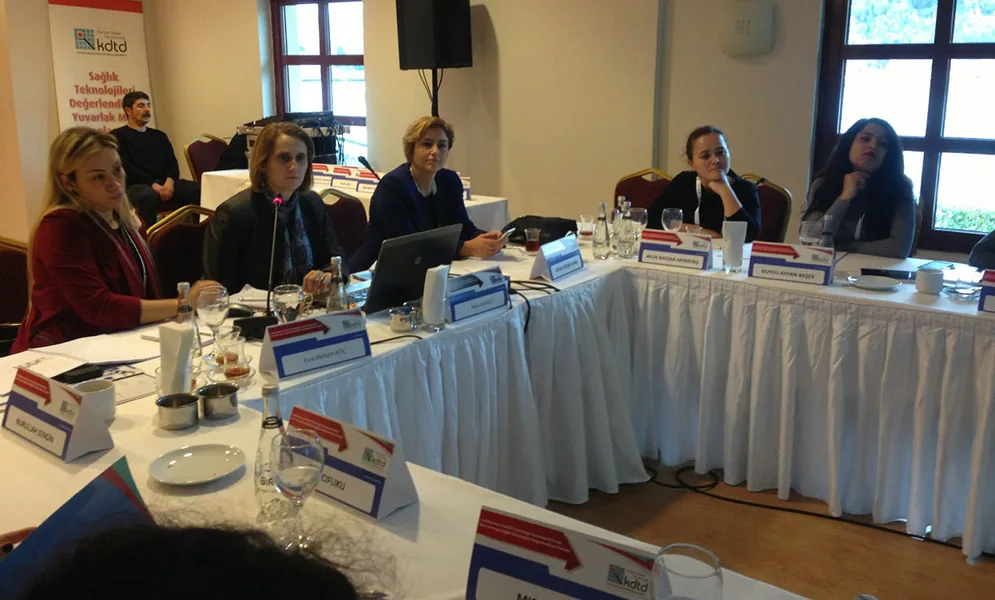
3rd HTA Round Table, 27 November 2015, İstanbul Haliç Congress Center — held the day before the 2nd Eurasian HTA Forum at the same venue.
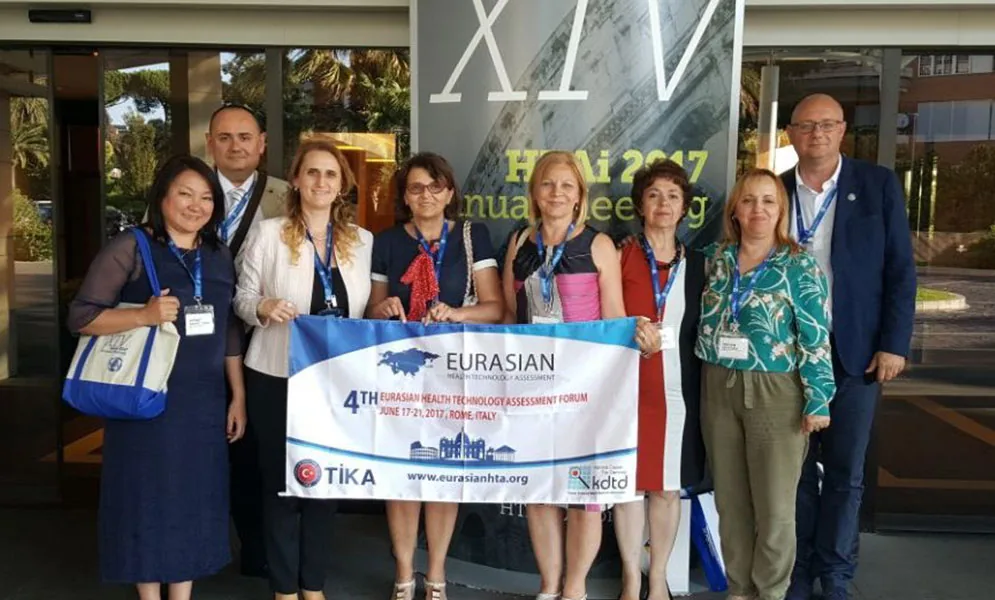
Participants of the 4th Eurasian HTA Forum at the HTAi 2017 Annual Meeting, Rome, 17–21 June 2017.
Highlighted countries took part in the 2015 Eurasian HTA meetings. Click a country — or its gold pin — to open the national profile presented there.
Gold countries on the map mark members and the observer that joined the 2015 meetings. Click one to read the HTA profile presented there.
Albania joined the Initiative as a new member at the Istanbul meeting in November 2015. The Ministry of Health remains the major funder and provider of a mainly public health system. The National Centre for Quality, Safety and Accreditation of Health Institutions (NCQSA), established in 2005, coordinates quality assessment and clinical guideline work.
Azerbaijan took part in the kick-off meeting in Ankara in March 2015. The country did not attend the second meeting in Istanbul in November 2015. A national country presentation was not included in the 2015 forum pack.
The Federation of Bosnia and Herzegovina has a Book of Rules on the introduction of new health technologies in healthcare institutions and private practice, and on the procedure of approval for their use (Official Gazette of FBiH no. 70/14), based on the Healthcare Law.
Kazakhstan presented a national HTA and standardization system based at the Republican Center for Health Development. HTA sits alongside clinical protocols, service standards, evidence-based medicine centres and disease-management programmes.
Kyrgyzstan presented institutionalization of health reform as the base for developing HTA initiatives. Health reform began in 1992, with a strong national programme for evidence-based clinical guidelines. Formal HTA was still absent in 2015, and the ISPOR Kyrgyzstan Chapter was established that year.
Montenegro presented HTA as a defined but not yet implemented part of its quality and patient-safety reforms. The Law on Health Care assigned the Ministry of Health to define criteria, standards and guidelines for HTA. A Book of Rules for HTA had not been adopted by November 2015.
North Macedonia presented HTA as a bridge between evidence and policy-making, alongside a legal obligation to use clinical guidelines and growing pharmacoeconomic work. An ISPOR Macedonia Chapter was established in 2011.
Tunisia joined the Istanbul meeting as an observer. INASanté — the National Instance for Accreditation in Health Care — was created by decree on 6 September 2012. It was presented as the second HTA and accreditation agency in the WHO EMRO region and on the African continent.
Türkiye leads the Initiative through the Turkish Evidence Based Medicine Society, with the support of TİKA. Rabia Kahveci’s meeting lecture set out HTA as policy research that sits between evidence-based medicine and evidence-based policy-making.